
Ag Contractors for Steep Hill Country: What to Check First
No Mans Land Mowing • October 21, 2026
For steep hill country, choose an agricultural contractor with machinery suited to the ground, proven operating hours and a written safety plan. A remote-controlled tracked mulcher keeps the operator off the slope. Current health and safety pre-qualification is worth checking before price, but it does not replace a site assessment.
At No Mans Land Mowing, we work on slopes of 50+ degrees across the Bay of Plenty, Waikato, Coromandel and Auckland. You can see our steep slope mulching and weed clearing services
or read about tractors versus mulchers for Waikato sidlings.
What makes steep-terrain contracting different from regular farm contracting?
A tractor suited to baling on rolling country is not automatically suited to clearing a steep gully. WorkSafe NZ's agriculture guidance identifies tractors and machinery as a leading cause of work-related death and serious injury on New Zealand farms. Rollovers on sloping ground are a recurring cause. Remote control keeps the operator off the machine and away from its rollover path. Tracks spread machine weight over a wider footprint than wheels, helping on soft or uneven ground. Neither feature makes unsuitable ground safe. We have 4,500 hours of operating experience on MDB LV600 machines. Machine-specific hours carry more weight than a general claim of contracting experience, particularly when clearing mature gorse on rough slopes.Do you still carry duties under the Health and Safety at Work Act when you hire?

Yes, if you engage the contractor as a person conducting a business or undertaking, known as a PCBU. Under the Health and Safety at Work Act 2015, overlapping duties do not transfer to the contractor. WorkSafe NZ says PCBUs sharing duties must consult and coordinate their activities.
Risks must be eliminated so far as reasonably practicable, or minimised where elimination is not reasonably practicable. For slope work, that means assessing the ground before starting and reviewing controls as conditions change.
A written plan should cover the hazards each party knows about and who controls them. This is general information, not legal advice; a private homeowner's position can differ from that of a working farm.
Which pre-qualification should a contractor show you, and what does it check?
Pre-qualification checks a contractor's health and safety systems. It does not establish whether a particular slope can be worked safely. It is recommended that you ask which scheme the contractor holds and request current paperwork. SHE/Tōtika health and Sitewise safety pre-qualification are used by many principal contractors and councils for tendering for public sector work. We hold all three pre-qualifications listed above. Current paperwork is a useful starting point, followed by the plan for your block.Can a remote-controlled mulcher work on 50+ degree slopes?

On suitable ground, yes. We work on slopes of 50+ degrees, but ground conditions determine the allowable steepness. Firm compact soil and grass permit steeper work than soft ground such as clay.
Why the ground sets the limit
The same measured angle can present very different traction and stability problems. Loose soil or wet clay changes how a tracked machine holds on the slope. The slope angle alone is not enough to approve a job.Why spring changes the day
Bay of Plenty spring growth can coincide with soft ground and reduced traction. It is recommended that conditions are checked on the day, rather than judged from the forecast or last week's visit. Slashing woody weeds leaves large sharp debris that stock will not walk over, while weeds regrow rapidly from remaining root and stem material. Mulching breaks the woody material down instead. Read more about non-spray clearing of gorse on slopes.How much ground can a tracked mulcher clear in a day?

Dense mature gorse takes far longer per hectare than grass or light regrowth. Stem diameter and slope affect output, as does access between work areas.
A daily area figure given without inspecting the block is an estimate, not a dependable production rate. A recommended next step is a walk-over, followed by an agreed scope based on the vegetation and ground.
What should you have ready before the machine arrives?
Hidden fences and unmarked plants can complicate clearing. Before work starts, it is recommended that you confirm:- Access routes and gate openings.
- Any water or swamp areas that maybe hidden below weeds (if known).
- Fence locations, marked on the ground or a plan.
- Who speaks on behalf of the property. Incase a decision is needed.
- Native trees or seedlings to retain we can identify most species during work.
- If a complete clear up of area is not required a clear picture for the operator to stick too.
What happens when a debris strike damages the machine or your land?
A pre-mulching inspection cannot find everything hidden in dense scrub. Debris strikes are part of this work. It is recommended that a verbal agreement on how damage will be sorted, and who carries liability before clearing starts. We run an in-house repair facility, which keeps repair costs low. A quick chat for a particular incident to see who is liable for any repairs if damage occurs. Not a “blame game” just a realistic conversation on the situation.Frequently asked questions
Does mechanical mulching near an orchard risk chemical spray drift?
No. Mechanical mulching uses no chemical sprays, so the clearing itself creates no spray drift. Orchard boundaries matter locally: the ANZ Bay of Plenty Regional Spotlight Report puts regional horticulture exports at $2.65 billion in 2025.Do I need to haul away the material after a mulching job?
Usually there is little to haul away because the mulching head reduces vegetation to chip on site. It is recommended that you agree how any remaining material will be handled before work begins.Does mechanical mulching stop woody weeds coming back?
No. Mulching breaks down standing vegetation, and our method has achieved very good results from lack of regrowth, but woody weeds can regrow from surviving roots and stem material. Follow-up control may be needed; a cleared slope is not a guarantee against regrowth.Which council rules apply to weeds on my property boundary?
Bay of Plenty Regional Council, Toi Moana, administers the regional pest management plan, covering declared pests including woolly nightshade and wilding conifers. The obligations depend on the species and location, so it is recommended that you check the current plan for your property. District councils also manage vegetation on their reserves and roadsides.
Access, ground and slope decide whether a tracked remote grinder can clear a stump on an Auckland bank, and what to send for a fair quote.
Mulching clears the standing growth of couch grass on steep hills, but its underground rhizomes regrow. Here is how to identify it, check the ground and plan the follow-up.
Kikuyu grass forms mats that mowing alone cannot clear. Here is why it spreads, what to check before the first pass, and how follow-up keeps it in check.
Hedge trimming services suit light annual growth on a maintained boundary. Gorse, blackberry and dense woody scrub need a mulching assessment instead, and this piece shows how to tell them apart.
Steep Rotorua banks are hard to mow with a ride-on, especially after October rain. Here is what drives the cost and when remote-controlled mulching makes more sense.

Hydrocotyle includes native New Zealand pennyworts as well as weeds, so identify it before clearing a damp bank near water. Here is what to check first and when to call a professional.
Hedgerow removal on a steep fence line means finding the wire and isolating the energiser before any machine goes in. Regrowth needs a plan too.
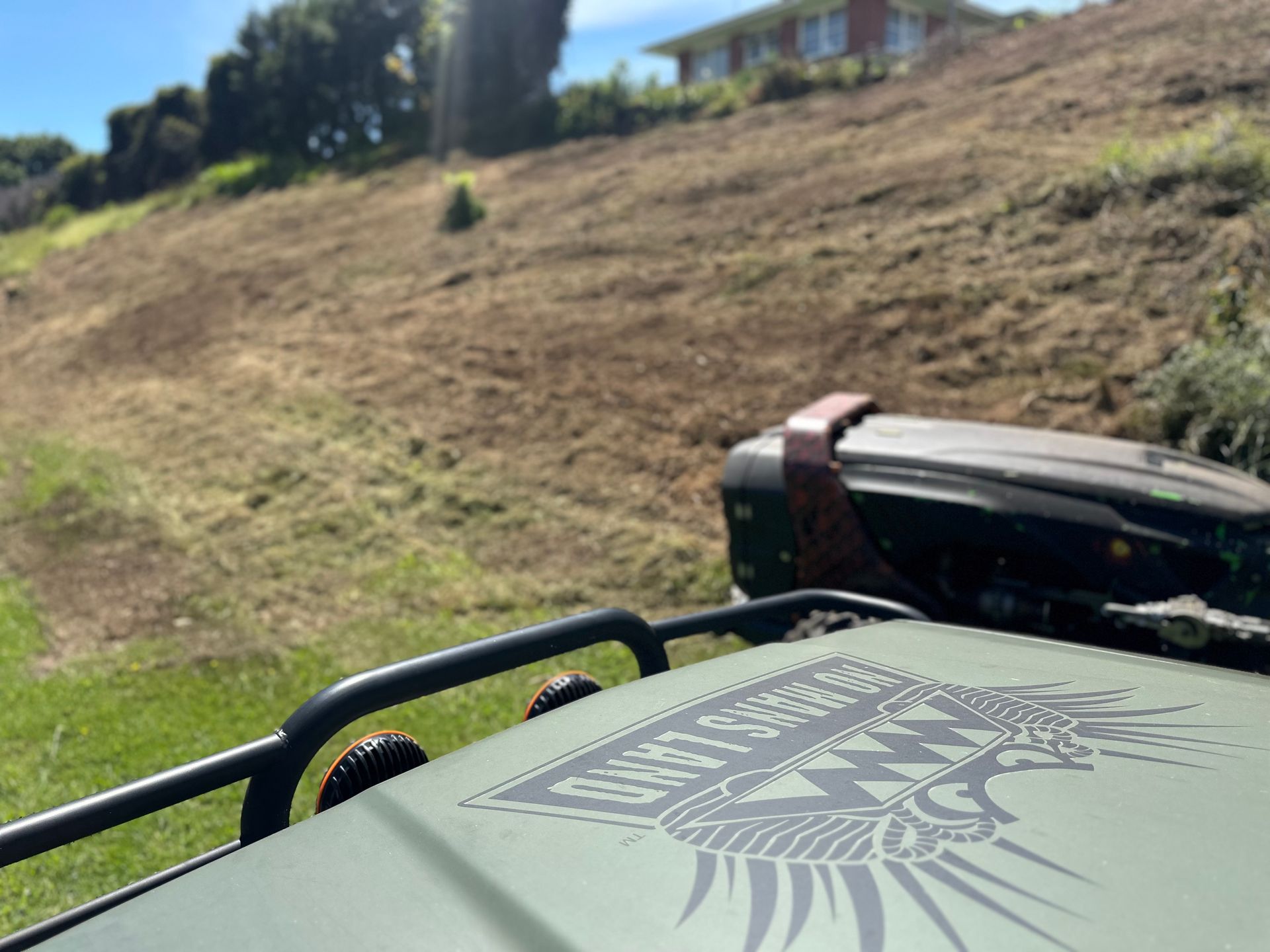
Grinding a tree stump below ground on a steep slope is usually safer than digging out its roots. The ground needs checking first, and the stump size alone does not settle the job.
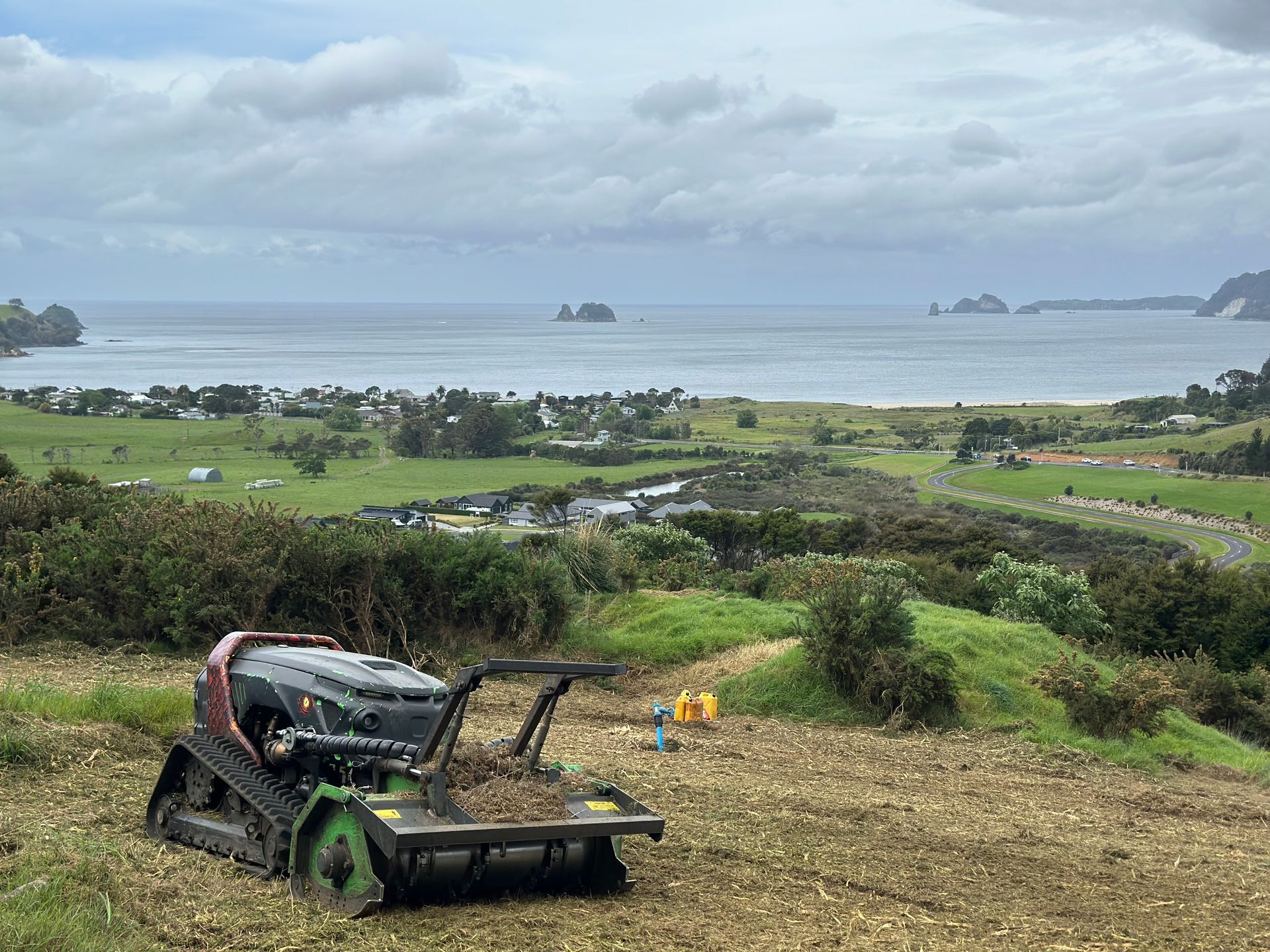
Mechanical mulching clears gorse and blackberry on steep slopes without herbicide, and the ground and follow-up decide how well the clearing holds.
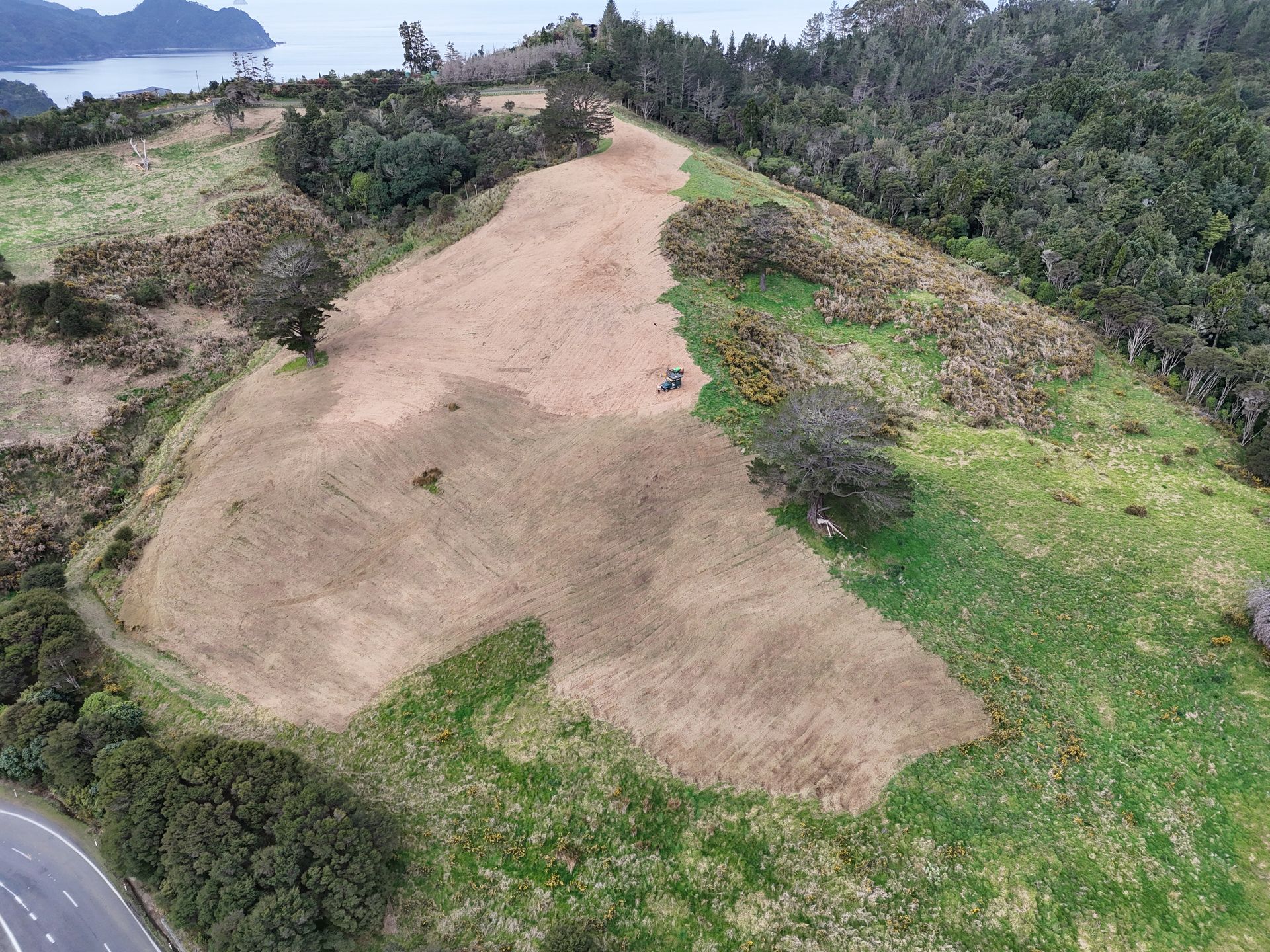
Published NZ price guides put tree felling at $350 to $5,000+ including GST, and steep banks often sit higher. Here is what changes the price and what to confirm in a quote.